Tuesday, November 9, 2010
Bud, Not Buddy by Christopher Paul Curtis
This book made me laugh out loud, seriously. I enjoyed the voice of the MC. You could really hear him talking and thinking to himself, which ten year old boys can be quite creative in their thinking...which leads to why I laughed out loud in a hospital lobby while reading this book.
I also loved that Mr. Curtis used his two grandfathers as characters in this book. One was a musician and the other was named "Lefty Lewis". How fun is that? Also, the author is from Flint..just another cool fact that was at the end of the book.
Saturday, November 6, 2010
Bleak House - Charles Dickens
Basically Bleak House is the story of a lawsuit and its effect on those who live in its periphery, but really it's a lesson in characterisation. There are 1088 pages in my copy of the book, and I swear a new character was introduced on each page. As a random selection, there's Tulkinghorn, the creepy menacing lawyer, there's the man-child Richard Skimpole who starts off as a delighful character, but whose childishness just makes him quite awful in the end and there's Richard Carstone who begins as a sunny care-free character but who pays the price for becoming with consumed with the law suit, or the 'family curse' as it's known. My favourites though are the Bagnets - Mrs Bagnet is an awesome mother-hen of a woman who bosses everyone around, and Mr Bagnet expresses his views solely through his wife -
Mr. George produces his present, which is greeted with admiring leapings and clappings by the young family, and with a species of reverential admiration by Mr. Bagnet. "Old girl," says Mr. Bagnet. "Tell him my opinion of it."
"Why, it's a wonder, George!" Mrs. Bagnet exclaims. "It's the beautifullest thing that ever was seen!"
"Good!" says Mr. Bagnet. "My opinion."
But as he also says -
"George," says Mr. Bagnet. "You know me. It's my old girl that advises. She has the head. But I never own to it before her. Discipline must be maintained."
I could go on about this book, but I won't. It was epic, and challenging, and hilarious, and hearbreaking and I'm glad I read it.
Wednesday, November 3, 2010
The Shakespeare Stealer by Gary Blackwood
It starts with Widge, an orphan taken in as an apprentice. He learns a secret written code from a doctor, who then sells him to a man who wants Widge to use this skill to copy one of Shakespeare's plays, Hamlet. Widge is successful after his second trip to the theatre, but it gets stolen from his wallet. He then pretends to want to be a player so he can steal the play and save his life from his new master. But, it is tough to steal. One, they keep it locked up in a chest in a locked room. And two, the players become family, something he has never had. And he makes friends, something he has never done. Can he betray them? It's a tough decision that keeps you reading to see how he will make the right decision and still live.
Saturday, October 30, 2010
a sad(ish) Gaps story
Warning: this is going to be a negative review, but in fairness to the author, it has nothing to do with his work on the book (I am sure this is a very good book, since other people much smarter and better read in this field than I am have said so). It's just a reflection of my hopes and expectations for the book. And, I guess, a manifestation of what the Gaps list helps us get out of our systems.I bought God's War back in 2005 off of a starred Publishers Weekly review. Back then, $35 was a huge amount of money for me to spend on a book (heck, it still is, but I was a bona fide starving assistant back then), but I love to read about the Crusades and have always sought stuff out. The PW review assured me that God's War would replacing the current standard Crusades text (by one Runciman, which yes, I had read in college already).
I was disappointed from the beginning with Tyerman's tone, which was the traditional dry academic, bent on including as many details as possible but without including anything hard, like numbers (let's face it, what we really want to know is always how many people died horribly). I mean, this was hardly Tyler's fault; he is an academic, and wrote an academic text. I guess I was just hoping that someone would finally write a treatment of the Crusades that made the data and the themes easy to digest. Because I know there's a way. And it bothers me that no one ever wants to cover this large topic in a plainspoken and accessible way. I believe a lot of us modern souls could learn a lot from history--this history in particular--if only historians were more willing to distill their jargon and say something.
I'll stop with that line of thought now. I don't mean to open up a basket of snakes about academic integrity, the moral imperative of keeping a neutral tone to data, the sanctity of the white tower, the fact that any written history is already an interpretation, blah blah blah. I was just hoping, when I bought this book, that it would be what I hadn't found elsewhere before--a book about the Crusades that I could recommend to casual readers. It wasn't.
It had already sat on my shelf for almost four years when we embarked upon the Gaps project (now more than a year and a half ago). I put it on the list, because I thought maybe this would finally get me through it. In order to get through it, I marked it into sections. I would try to read about 75 pages a week, and it would take me only three months of Sundays to finish it and have done. I lasted for two weeks on that plan. Well, one and a half weeks. I was thrown off by the fact that nothing felt new or fresh--I was just rereading difficult-to-pick-through historianism with the same content I already knew backward and forward. Six months later, I plowed through another 50 pages, then six months after that, while I was briefly unemployed, I forced myself through another 400. Today, I made myself finish it, and forgave myself much skimming. I hope no one will fault me for crossing it off the list, despite rather light engagement over the last three hundred pages.
Anyway, now I'm done. The Gap is filled. Any writers out there in need of projects? I still vote for a short, accessible, general, thematic, and fun to read history of the Crusades.
Friday, October 29, 2010
Dracula ~ by Bram Stoker (audio version)
"I am Dracula, and I bid you welcome . . . "
An enduring classic with an extremely charming, truly evil, yet almost human monster. I suggest leaving the lights on.
Synopsis: With a Victorian setting in the late 19th century, a newly practicing attorney/solicitor from England is commissioned to visit a new client for his firm. He is to meet with this wealthy gentleman and stay at his castle in the mountains of Transylvania, while giving him advice on property acquisitions within the UK. The journey starts out decently for Jonathan Harker, but “red flags” pop up as he is warned by the locals and experiences eerie events during his journey to the Count’s country estate.
When he reaches his destination things are not as he was lead to believe. He finds that the Count himself is misleading and extremely intelligent, with a business savvy to match. Most disturbing is when Harker realizes the castle has no servants, parts are in complete ruin, he sees the count doing not very human things, and it appears that he is in fact a prisoner with in the castle. When he finally returns home, the young lawyer is beside himself, and worse yet it appears that he may have been followed. This scary story has only just begun.
Thoughts: This is a wonderful tale which deserves to be read by anyone interested in classics, horror, and evil vampires. That it was written over 100 years ago and the emotions it incurs are still heart quickening, attest to the universal nature of this horror story and make it an enduring classic.
Set partially in Whitby, an amazing town on the East coast of England with iconic structures which still exist today, the story includes a variety of interesting and well developed characters, with our main character the Count, who is the evil embodiment of a sociopathic killer.
It is all told in letter format - epistolary or diary entries with each character well developed and interesting. Listening to the book in audio format, the telling is done via various voices and is close to perfect - old English accents, changing for each of the characters. I enjoyed it immensely.
As for rating this classic I would say 4.5 stars. I recommend this version if you decide audio is the way to go for you.
Some Information about Whitby via travel pictures.
Below are pictures which John and I took in 2009 on one of our many visits to England where he is from. When experiencing this book in its audio format these images helped it come alive for me. I could not help visualize this setting as it was described by the author. Also included below are several links to festivals based in the area, and a picture of our brother in law in full Dracula regalia at one such event which occurred last year in the town.
Whitby is on the Eastern side of Northern England. Set on the North Sea. The water is wild and choppy and very cold even in summer. This picture was taken from the pier which is located at the bay/river mouth and is a Southern outcrop of highland. Making this a perfect spot to watch incoming ships or marauders in this ancient port city. It is also the spot where the gorgeous abbey is located,
This was taken during the summer June 2009. It was truly cold and windy, the norm for the area. Further to right on the mesa you can actual see the little bits of the abbey’s spires. It is a key feature in several of the settings described in Dracula.
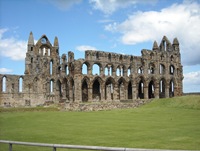
Above are two pictures of the ancient abbey. They are described in the book exactly as they are pictured here. It was lovely walking through and inside the abbey, looking up at the architecture. Here is the historical setting for the spot:
The first monastery here was founded in AD 657 by King Oswy of Northumbria. An Anglo-Saxon style 'double monastery' for men and women, its first ruler was the formidable royal princess Abbess Hild. Here, Caedmon the cowherd was miraculously transformed into an inspired poet; here, the future of the English church was decided by the Synod of Whitby in 664; and here the relics of Northumbrian kings and saints were enshrined.
from the non profit site – English Heritage.org.
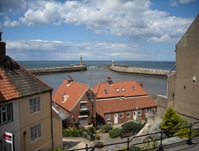
These are pictures of the hillside town walking down from on top of the plateau where the abbey is situated. We walked down on the cobbled streets from a very very old cemetery that is West from the abbey. On the left you can see across the channel and to the left the man made water breaker, which prevent the wild waters from coming into the river/bay. This water way is an important setting within the book as well.
To the right is my English brother in law, dressed as Dracula at a local festival held in Whitby, which the entire family attended.
If you are interested further, there is a gothic blog called Dracula in Whitby which gives you up to date information on a variety of festivals happening in the area.
Normally I would not include links to purchase, however since there are so many version and so you can link to the correct version I have done so on this post.
Amazon purchasing links - US/UK/Canada or The Book Depository - AUD and Euro. Amazon is an affiliate (where we only make cents per book) but Book Depository is not.
Happy Halloween!
Thursday, October 28, 2010
The Victorian Chaise-Longue by Marghanita Laski
Yet I hesitated to read The Victorian Chaise-Longue. Could it possibly live up to such high expectations? Wouldn’t it be awful to not have something new by Marghanita Laski still to read?
The second problem was solved when Persephone Books kindly reissued To Bed with Grand Music. It was time to open the pages of The Victorian Chaise-Longue.
Could it live up to my expectations?
“Will you give me your word of honour,” said Melanie, “that I am not going to die?”
It is the middle of the twentieth century. Early in Melanie’s pregnancy her doctor found a patch on her lung – an early sign of tuberculosis. She now has a son, but she hasn’t been allowed to leave her bedroom or be in close contact with her child since the birth.
But now Melanie’s health is improving, and the doctor accedes to her wish to go downstairs and lie upon the Victorian-Chaise Longue.
It’s a strange piece of furniture. Old, worn and out of keeping with the rest of the house, and yet Melanie was drawn to it. She had to have it.
Melanie is spoiled, but she has charm and I couldn't help sympathising with her situation. And wondering to what degree her upbringing, her family and society had taught her to behave as she did.
She falls asleep on her chaise-longue. And she wakes up on it. But she wakes up a hundred years earlier, in Victorian England. Where is she? Why is she being called Milly?
Melanie thinks she is in a nightmare. She tries to wake up, but she can’t. This is real. She is trapped and helpless.
Marghanita Laski conveys her feelings quite perfectly. The atmosphere is claustrophobic, and deeply unsettling. And the more you think the more unsettling it becomes.
Melanie gradually finds out more about Milly’s life. The similarities in their lives and their circumstances are extraordinary, but the consequences in their different times are starkly different.
“We seem to be together now, she explained, you and I, both hopeless. I think we did the same things, she told her, we loved a man and we flirted and we took little drinks, but when I did those things there was nothing wrong, and for you it was a terrible punishable sin.”
It would be unfair to say too much more, but the situation and Melanie’s emotions intensify as the story build to a conclusion.
The Victorian Chaise-Longue works on more than one level. It is a fine piece of storytelling and it is also a striking analysis of the changing position of women in society.
And while many authors would make a lengthy novel out of this material, Marghanita Laski distils it perfectly into just 99 pages.
The writing and the characterisation is as wonderful as my previous experiences with her writing had led me to expect.
And, once again, Marghanita Laski has come up with a stunning final sentence. How does she do that?!
The Victorian Chaise-Longue definitely lived up to my high expectations.
Tuesday, October 26, 2010
The Tales of Despereaux by Kate DiCamillo
But, this story doesn't just follow Despereaux. It also follows a young servant girl named Miggery Sow and a rat named Roscuro. And you see how these three lives intertwine with the Princess Pea and the dungeon. It is really quite a clever story with lots of depth in character development.
I loved the voice in this book. There are many stops and the "Narrator" speaks to the "Reader". This "Narrator" had questions for us to ask ourselves, which usually were answered a few lines after the question. This really drew us into the storyline as we watched it unfold.
The drawings in the book are well done and add a depth to the reading.